
Luna prospect pipeline: weekly discovery grounded in first-party evidence, with a person choosing every prospect
A weekly pipeline that discovers businesses through three lanes, reads their own websites for evidence, has Luna review five evidence dimensions and Python validate the result, and hands a short, auditable shortlist to a person.
Key facts
- 3Discovery lanesTwo Google Places lanes and one App Store lane
- 5Evidence dimensionsReviewed by Luna for every candidate
Context and problem
Finding businesses that fit an offer is slow, and lists built from directories alone are full of guesses. I wanted a weekly shortlist where every prospect is backed by what the business says on its own website, and where a person still makes every choice.
Architecture
How to read it. The top row is the weekly run, left to right; the bottom row returns from right to left to the person. Every phase writes to SQLite, so a run can resume and history is kept. The highlighted box is the operator: nothing downstream happens until a person selects from the shortlist.
A scheduled task runs once a week and makes two passes, one per offer. Three discovery lanes find candidates: Google Places for front-desk businesses and for professional services, and the Apple iTunes Search API for app publishers. The pipeline collects and deduplicates them, then visits each business’s own website with Playwright, respecting robots rules, to gather first-party evidence.
Three phases follow. Deterministic Python filters extract facts and drop clear misfits. Luna reviews each remaining candidate across five evidence dimensions. Python then validates the quotes Luna relied on and computes the outcome: qualified, monitor and retry, or drop. SQLite keeps durable state, history and backups, and the qualified prospects become one weekly shortlist.
Decisions and trade-offs
- First-party evidence over directory data. A prospect qualifies on what its own website shows, not on a category label.
- The model judges, code decides. Luna reviews the evidence, but deterministic Python validates the quotes and computes the result, so every outcome can be audited.
- A short product, a long memory. The weekly output stays a concise shortlist, while SQLite keeps the full history so nothing is re-processed by accident.
Governance and cost
A person selects from the shortlist. Contact verification and outreach files are optional steps that only run after that selection, and nothing is sent automatically. The scrape is robots-aware and limited to first-party websites. No real businesses or contacts appear on this page: the screens below are architecture diagrams.
Outcome
In use, weekly. I make no claim here about prospects found or contacts converted.
What comes next
Tracking which shortlisted prospects turned into conversations, so the five evidence dimensions can be tuned against real outcomes.
Screens
Screens from the working tool. Private details such as amounts, contacts and client posting text are covered or left out. Select a screen to enlarge it.
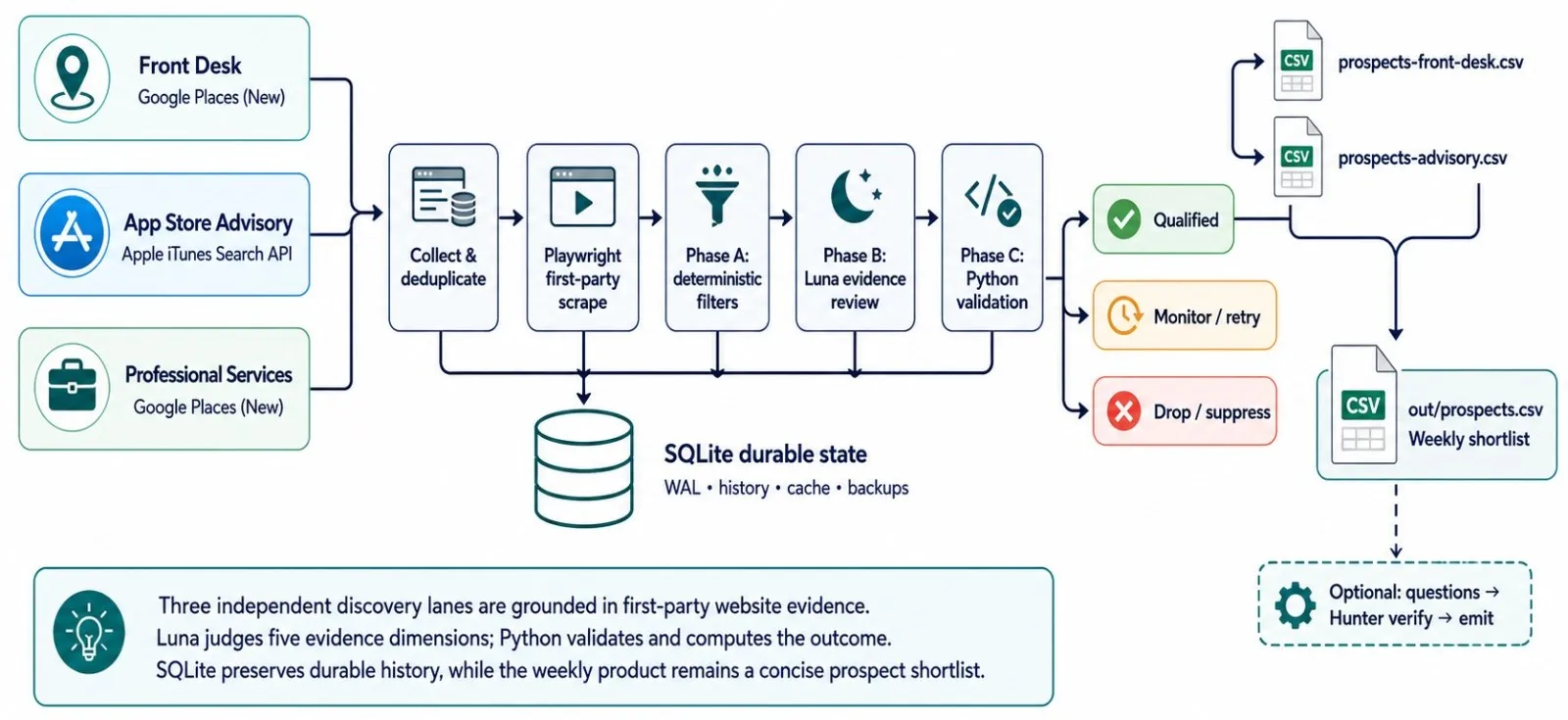
Logical architecture three discovery lanes
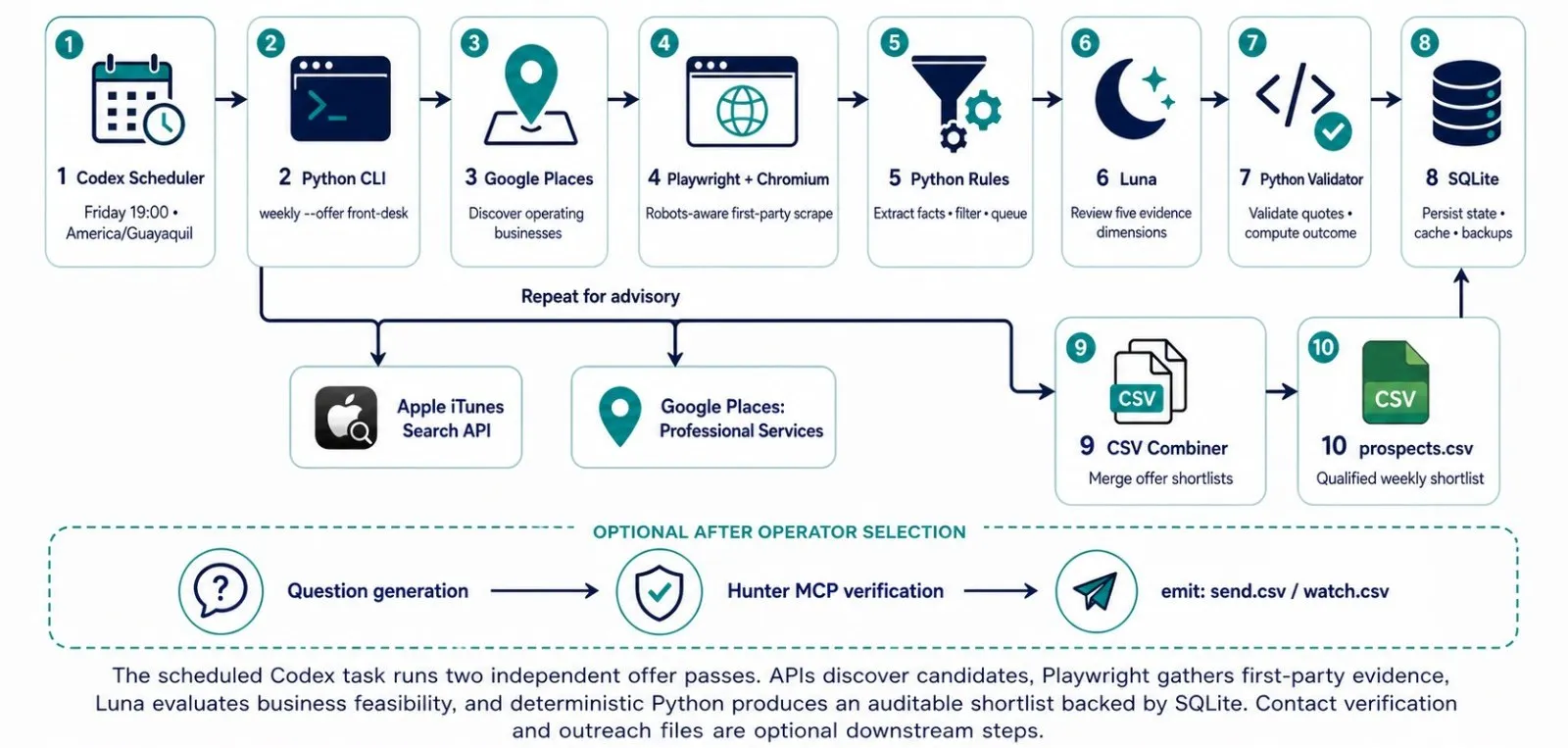
Weekly automation flow and tools